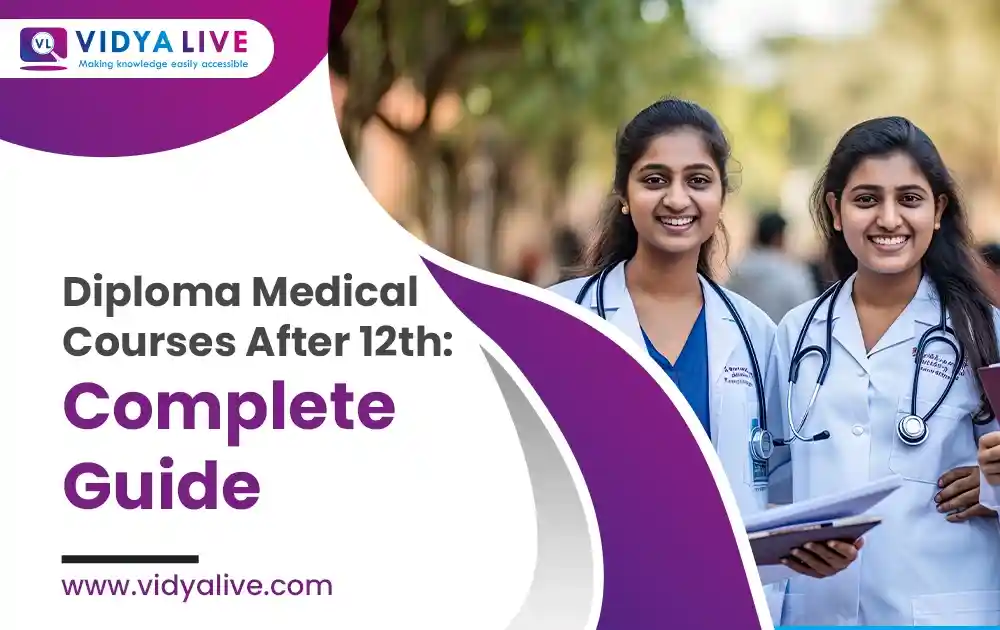
Selecting a medical career after 12th does not necessarily call for NEET. Several candidates search for medical courses after 12th without NEET, as cracking the exam has become tremendously competitive over the years. The increasing cut-offs, limited number of MBBS seats and severe preparation stress usually inspire candidates to discover alternative healthcare careers. At the same moment, some candidates prefer skill-based programs that provide faster employment prospects than spending years preparing for doctor-level courses. The good thing is that in India, there are various rewarding options beyond MBBS comprising nursing, pharmacy, physiotherapy, radiology, medical lab technology and other paramedical fields that do not necessitate NEET qualification.
What Are Medical Courses After 12th?
A medical course is a study programme that guides candidates in several facets of healthcare and medicine. Such courses prepare candidates with the acquaintance and skills required to diagnose, treat and care for patients. The medical courses after 12th are not just about becoming a doctor, but the healthcare industry also requires nurses, physiotherapists, lab technicians, radiographers, pharmacists, and many other professionals. Such courses fall under diverse categories.
Degree courses like B.Sc Nursing or Bachelor of Physiotherapy usually run for 3-4 years and offer inclusive training. Diploma courses in areas such as radiology or medical lab technology usually take 2 years and concentrate on dedicated technical expertise. Then there are certification programs that last 6 months-12 months, ideal for quick skill advancement.
Doctor-level courses such as MBBS, BDS, or BAMS need five to five-and-a-half years, comprising an internship. But courses after 12th medical field also comprise paramedical programs, allied health sciences, pharmacy, and nursing Course pathways. Each has its own entrance obligations, some require NEET, others have their own entrance exams or merit-based admissions.
The most significant thing is to comprehend that healthcare is not a one-size-fits-all career path. The appropriate course for one candidate may not work for another. The decision must rely on personal interests, financial budget, the amount of time willing to invest in studies and the type of career a candidate wants to develop in the future. Some candidates prefer long term doctor courses, whereas others select practical, job-oriented programs that assist them initiate earning earlier.
Your choice should depend on your interest area, how much time you can invest, your budget, and your career goals.
Year-Wise Medical Courses After 12th
1 Year Medical Courses After 12th
Short-term medical courses are perfect in case candidates want to initiate earning promptly or are not prepared for a long academic commitment. Such certification programs provide rigorous training in precise areas.
The Certificate in Medical Lab Technology guides candidates to conduct fundamental diagnostic tests. The students get to learn blood testing, urine analysis, and sample handling.
|
Duration |
Fees range |
Starting Salaries |
|
10-12 months |
₹20,000 to ₹60,000 |
₹12,000 to ₹18,000 per month in smaller labs, more in cities |
The Certificate in X-Ray Technology covers radiography basics. It is suitable if candidates are interested in diagnostic imaging but do not want a two-year diploma commitment.
|
Duration |
Fees range |
Starting Salaries |
|
6-12 months |
₹30,000 to ₹80,000 |
₹15,000 to ₹22,000 initially |
Emergency Care Assistant courses supervise trauma care, first aid, and emergency response. With healthcare amenities mounting, there is an increasing demand for trained emergency staff.
|
Duration |
Fees range |
Starting Salaries |
|
12 months |
₹25,000 to ₹50,000 |
₹14,000 to ₹20,000 per month initially |
The Dialysis Technician Certificate is another one-year option. As kidney-related diseases increase, dialysis centers require trained technicians.
|
Duration |
Fees range |
Starting Salaries |
|
12 months |
₹40,000 to ₹1,00,000 |
₹15,000 to ₹25,000 per month initially |
These 1 year medical courses after 12th are best apposite for candidates who require instant employment or want to explore the field before committing to long-term programs. The candidates can always boost further with diplomas or degrees.
2 Year Diploma Medical Courses After 12th
Diploma in medical courses after 12th offers more thorough knowledge than certificates and enhanced job opportunities as compared to one-year courses. These programs ensure a balanced approach between time investment and career potential.
Diploma in Medical Lab Technology (DMLT) is possibly the most popular two-year diploma. The candidates get to learn advanced diagnostic techniques, microbiology, pathology, and lab management.
|
Duration |
Fees range |
Starting Salaries |
|
Two-year |
Government colleges charge ₹20,000 to ₹50,000 total, while private institutes may ask ₹1, 00,000 to ₹2, 50,000 |
₹18,000 to ₹30,000 |
Diploma in Radiology emphasizes on X-rays, CT scans, MRI, and other imaging technologies. It is a technical sphere with steady demand.
|
Duration |
Fees range |
Starting Salaries |
|
Two-year |
₹50,000 to ₹2,00,000 |
₹20,000 to ₹35,000 |
Diploma in Operation Theatre Technology equips candidtes to help during surgeries. The students will learn surgical instruments, sterilization, patient preparation, and OT management.
|
Duration |
Fees range |
Starting Salaries |
|
Two-year |
₹60,000 to ₹2,00,000 |
₹18,000 to ₹32,000 |
Diploma in Physiotherapy is a two-year program in many states, though a bachelor's degree is becoming more widespread. It comprises therapeutic exercises, patient rehabilitation, and pain management. Physiotherapy offers a good scope in sports medicine, hospitals, and private practice.
|
Duration |
Fees range |
Starting Salaries |
|
Two-year |
₹50,000 to ₹2,50,000 |
₹20,000 to ₹35,000 |
These 2 year diploma medical courses offer precise skills without requiring 4-5 years of study. These are convenient choices for candidates who want to balance education time with career access.
3–4 Year Degree Medical Courses After 12th
Degree medical courses after 12th provide comprehensive education and usually open more career advancement prospects than diplomas. Most necessitate entrance exams or merit-based admission. 3-year medical courses list has been stated as:
B.Sc Nursing is a four-year degree (three years plus one year internship in some universities). It is one of the most esteemed paramedical courses, above all for those who like patient care. The candidates can experience excellent growth and opportunities abroad.
|
Duration |
Fees range |
Starting Salaries |
|
3-4 year |
Government college fees are ₹20,000 to ₹1, 00,000 total, private colleges charge ₹2, 00,000 to ₹8, 00,000. |
₹25,000 to ₹40,000 |
Bachelor of Physiotherapy (BPT) is a four-and-a-half-year degree including an internship. It offers better career prospects than a diploma. BPT graduates and experienced physiotherapists with private clinics can earn much more.
|
Duration |
Fees range |
Starting Salaries |
|
4-4.5 year |
₹1,00,000 to ₹5,00,000 |
₹25,000 to ₹45,000 |
Bachelor of Medical Lab Technology (BMLT) is a three-year degree that goes beyond DMLT in scope and depth. The candidates get to study advanced diagnostics, research techniques, and lab administration.
|
Duration |
Fees range |
Starting Salaries |
|
3 year |
₹1,00,000 to ₹3,50,000 |
₹22,000 to ₹38,000 |
Bachelor of Pharmacy (B.Pharm) is a four-year degree with excellent job prospects in pharmaceutical companies, hospitals, and drug manufacturing. Pharmacists get to experience major growth prospects in research and quality control roles.
|
Duration |
Fees range |
Starting Salaries |
|
4 year |
Government colleges charge ₹50,000 to ₹2, 00,000, private ones ₹3, 00,000 to ₹8, 00,000 |
₹20,000 to ₹40,000 |
Bachelor of Audiology and Speech-Language Pathology (BASLP) is a newer but growing field. It's ideal if you're interested in communication disorders and rehabilitation.
|
Duration |
Fees range |
Starting Salaries |
|
4 year |
₹2,00,000 to ₹6,00,000 |
₹25,000 to ₹45,000 |
These 3 year medical courses (and four-year variants) are firm investments in case candidates can afford the time and money. They offer robust academic foundations and enhanced long-term growth.
5+ Year Medical Courses (Doctor Courses)
These are the traditional doctor courses after 12th that require significant obligation but offer the utmost esteem and earning prospective in healthcare setting.
MBBS (Bachelor of Medicine and Bachelor of Surgery) after 12th is the gold standard and takes five and a half years, including one year compulsory internship. NEET is mandatory for admission.
|
Duration |
Fees range |
Starting Salaries |
|
5-5.5 year |
Government medical college charge ₹50,000 to ₹5,00,000, whereas Private medical colleges charge ₹50,00,000 to ₹1,50,00,000 |
₹60,000 to ₹1,00,000, grows considerably after PG and specialization |
BDS (Bachelor of Dental Surgery) takes five years, including internship. NEET is obligatory here too. It is somewhat less competitive than MBBS.
|
Duration |
Fees range |
Starting Salaries |
|
5 year |
Government college fees are ₹50,000 to ₹5,00,000, private colleges ₹25,00,000 to ₹75,00,000 |
₹30,000 to ₹50,000 in clinics, but private practice can be highly lucrative |
BAMS (Bachelor of Ayurvedic Medicine and Surgery) and BHMS (Bachelor of Homeopathic Medicine and Surgery) are five-and-a-half-year AYUSH courses requiring NEET. They're good alternatives if your NEET rank doesn't get MBBS. The graduates have the opportunity to work in government hospitals, private clinics, and wellness centres.
|
Duration |
Fees range |
Starting Salaries |
|
5-5.5 year |
₹50,000 to ₹10,00,000 depending on the college |
₹25,000 to ₹50,000 |
These 5 year medical courses after 12th demand devotion, high entrance scores, and considerable financial investment. Though these courses remain the most prominent paths in a healthcare setting.
Medical Courses after 12th – Duration, Fees & Salary Comparison
|
Course Name |
Duration |
Approximately Fees |
Starting Salary |
Career Scope |
|
Certificate in MLT |
1 year |
₹20,000 - ₹60,000 |
₹12,000 - ₹18,000/month |
Diagnostic labs, small hospitals |
|
DMLT |
2 years |
₹50,000 - ₹2,50,000 |
₹18,000 - ₹30,000/month |
Labs, hospitals, research centers |
|
B.Sc Nursing |
4 years |
₹20,000 - ₹8,00,000 |
₹25,000 - ₹40,000/month |
Hospitals, nursing homes, abroad |
|
BPT |
4.5 years |
₹1,00,000 - ₹5,00,000 |
₹25,000 - ₹45,000/month |
Hospitals, sports centers, clinics |
|
B.Pharm |
4 years |
₹50,000 - ₹8,00,000 |
₹20,000 - ₹40,000/month |
Pharma companies, hospitals |
|
MBBS |
5.5 years |
₹50,000 - ₹1.5 crore |
₹60,000 - ₹1,00,000/month |
Medical practice, hospitals, research |
|
BDS |
5 years |
₹50,000 - ₹75 lakhs |
₹30,000 - ₹50,000/month |
Dental clinics, hospitals |
This comparison represents medical courses duration and the ways fees and salaries vary significantly. Government colleges almost always charge less but have limited seats.
Best Medical Courses after 12th Based on Career Goals
Selecting the best medical courses after 12th depends on the factors candidate value most in the career.
Medical Courses after 12th without NEET
Several candidates presume that all medical courses require NEET. This is not true. NEET is required merely for MBBS, BDS, and some AYUSH courses.
This reveals various Medical courses after 12th without NEET for candidates who either did not show for the exam or could not secure the desired rank. They can still embrace a thriving and rewarding healthcare career.
Career Scope after Medical Courses
The medical courses scope in India is widening swiftly because of the consistent progress of healthcare infrastructure and the increasing demand of skilled experts.
Healthcare demand in India is anticipated to progress significantly as India's population ages and health consciousness continues to thrive. Career options after medical courses remain resilient even during economic downturns.
Conclusion
Medical education offers opportunities for everyone, whether candidates can invest 6 months or 6 years and whether the aim is to become a doctor or advance a career in allied healthcare. The key is to select a course based on genuine interest, available time, financial considerations and long-term career anticipations, rather than merely following popular trends.
Not everyone needs to pursue MBBS to advance a flourishing healthcare career. A devoted nurse, skilled physiotherapist or skilled lab technician can attain equally rewarding and financially stable career outcomes. It is significant to discover options comprehensively, interact with professionals already functioning in the field, deliberate practical factors like course fees and job prospects and then take a mindful decision. The medical field requires devoted experts across all levels. The candidates need to find out where they can fit best, and entrust themselves to learning well. These way candidates will find an abundance of prospects waiting.